I was born in Ontario on January 22, 2003. My love of nature started young, and I was fascinated by the sea. My interest in the ocean led my family to gain the same love for sealife. From there, we decided to move to be closer to nature and by the ocean on Vancouver Island. During my early schooling years, I struggled to progress and was tested and found to have a disability in reading and writing. My love of nature and my disability led me to drawing. It was an activity I did not need to fight to do or understand. I was 11 when my family moved to Vancouver Island and this is when my art skills began to mature and form into what they are today. Being in an area that was full of wildlife inspired me to make art constantly and I became very skilled at drawing. I’ve had two mentors who helped me build my skills. One is a watercolour artist and the other was my high school art teacher. They taught me the fundamentals of watercolour, ceramics and drawing, and encouraged me to pursue the BFA program at UVic. Once enrolled, I started to experiment with acrylic paint and found that I was able to express myself fully using this medium. In 2025, one of my paintings called “I’m not political” was displayed in Killjoys. In 2026, my work was a part of the UVic BFA art show, Say When.
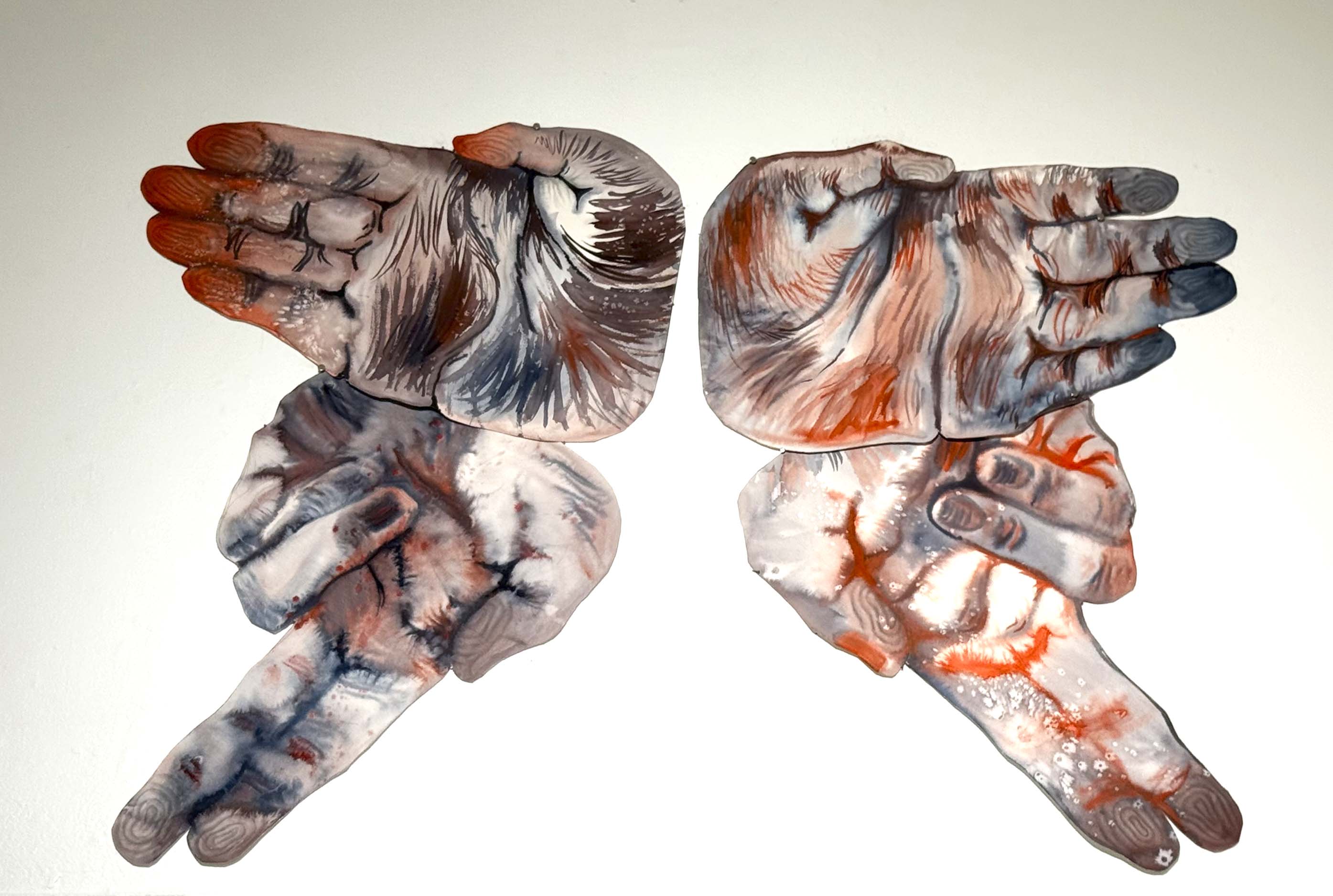
My artworks explore the separation that humans have put between themselves and nature. I use my artwork to show that we see ourselves in a different category than animals and nature. Many things connect us back to the natural world, but the one that is most salient is decay. The mediums I use to express these ideas are painting and drawing. I depict animals with power and urgency, and humans as rotted or distorted creatures. I also explore my own identity by distorting specifically the hands. Hands are something I am hyper-focused on, as I have picked and bitten my nails for most of my life. A large part of my identity is my family history as a Japanese Canadian whose family was interned in Canada during World War II. As such, my artwork often uses Japanese culture and depictions of traditional family objects. The object I am most drawn to is the hanaya mask, which I use as a representation of myself and my relationship to my own culture and my identity as a woman. Dogs are also a recurring image in my artwork. They are a reference to the only memories my grandpa shared from his time when he was interned in Canada during World War II. It is important to reflect on Japanese internment as it is something that seems to be reoccuring, but with different cultures. Showing what internment camps have done to degenerate culture informs what may happen long after these current events. My work explores the fear of expressing one's own heritage and culture and how cultural practices are not passed down because of this fear. These artworks are important as they are a part of Canada’s history that is often forgotten or unknown.